
Rugby has flexed its muscle in East London — and, for now, it has won what may turn out to be a major victory.
At Selborne College, a newly created rugby programme that briefly appeared to be veering off course is back on track, the reset as swift as it is telling. What looked like a potentially defining rupture has instead become something familiar in modern schoolboy rugby: a clash of philosophy, followed by an uneasy but necessary compromise.
The storm was ignited by a leaked letter. In it, Headmaster Andrew Dewar was cast, fairly or not, as an impediment to a new rugby direction shaped by the arrival of Jake White and a freshly appointed Director of Rugby. The fallout was immediate. The Headmaster’s reputation took a massive knock, and the narrative — once it escapes into the public domain — becomes notoriously difficult to control.
Beneath the noise, however, sat a deeper and more enduring tension. Among Old Selbornians and invested parents, frustration had been building. Results, the ultimate currency in schoolboy rugby, were reflecting a programme struggling to keep pace with an evolving landscape. The fear was not just about losing matches; it was about losing relevance.
The letter hinted at a philosophical divide — one rooted in time. Dewar’s stance, it suggested, belonged to an earlier era. And therein lies the crux of the matter.
Under his leadership, Selborne has cultivated a reputation as one of the country’s most values-driven rugby schools. That is no small achievement. It speaks to consistency, to character, and to a vision of education that extends well beyond the scoreboard. In another context, Dewar would be universally applauded for this leadership.
But schoolboy rugby has changed. Dramatically.
Today, it operates in a space where high performance, visibility, and institutional prestige intersect. It is no longer simply a co-curricular activity; it is a strategic asset. And like any asset, it demands return.
A headmaster remains the ultimate authority — the final sign-off, the custodian of a school’s identity. The role requires control, balance, and, at times, restraint. Strong leadership is not about surrendering that authority, but about knowing when to absorb pressure and when to redirect it. Particularly when external consultants enter the equation, often carrying ambitions that do not always align with a school’s broader educational ethos.
Yet rugby is not a passive stakeholder. It is assertive, influential, and, increasingly, uncompromising. It speaks the language of results, and it rewards those who listen.
So when Jake White briefly stepped away — and has now returned following a resolution — the conclusion is difficult to avoid. Somewhere in the process, ground was conceded. Whether that concession was tactical or philosophical remains to be seen, but it was enough to bring all parties back to the table.
And perhaps that is the reality modern headmasters must confront.
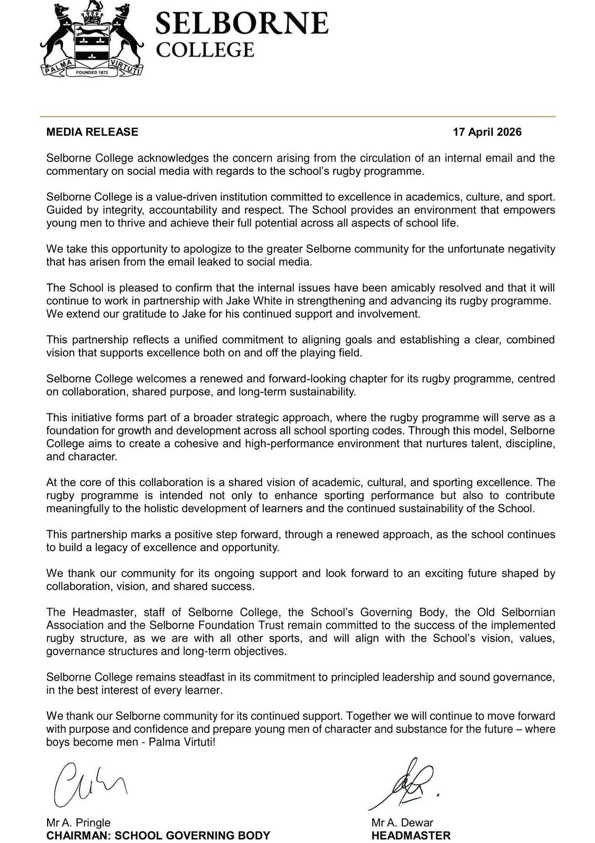
To remain competitive — and, more importantly, sustainable — there is an implicit understanding that certain lines may need to blur. The phrase buried deep within Selborne’s media release below, “the continued sustainability of the School,” may well be the most revealing of all. It is an acknowledgment of rugby’s influence — not just on results, but on enrolment, reputation, and long-term viability.
That is the uncomfortable truth.
Rugby, more than any other school sport in South Africa, has embedded itself into the institutional fabric. It attracts attention, drives narratives, and, in many cases, shapes the identity of a school. The question is no longer whether it holds power — that is beyond dispute.
The question is whether that power can be contained.
Or whether, in time, the balance will shift entirely — from headmaster to programme, from education to performance — until rugby is no longer a pillar of the school, but the axis around which everything else turns.
In East London, the immediate battle is over.
The larger one is only may just be beginning.
Selborne Media Release:
@Vleis (Comment #17)
Ok, let us agree to agree. It is easier than agree to disagree, or disagree to agree, and because disagree to disagree is not the same as agree to agree. 🤔
@Vleis (Comment #17)
They kissed and maked up.
@Djou (Comment #15)
There was, initially, a legal threat in the headmaster’s response – i.e. “I can’t say much because there is a legal team looking into the defamatory information on that letter.” Did he subsequently ‘see the light’ of his own accord, or under duress from the SBR community?
.
Nimium dīxī – let’s put this matter to bed and watch SC’s progression, with hope, from the sidelines.
@beet (Comment #14) Hi Beet. I started penning a long reply, but I’ve deleted it, as dragging this saga on for a longer period will not serve SC’s best interests. Besides, I suspect that you do not have my luxury of being able to be brutally honest. Let’s agree to disagree on some points.
.
Hopefully, the SC SBR community are saying: “Vici, sed caveo”.
@beet (Comment #14) This is so well reasoned and well written. I may add, when I read JW’s letter, I thought, OK, I want to see the principal’s reply, whether it will be public, and most important, if it is public, whether there will be a “legal threat”. The latter is all that a bystander would have needed to make up your mind on leadership and conflict resolution issues.
@Vleis (Comment #5)
Your opinion is much appreciated.
I believe Selborne is set to become a case study. I’m no saint—I too sided with the writer of the original letter to the Selborne SGB. I see the school world through the eyes of a schoolboy rugby supporter. Even though I have no connection to Selborne, I have been frustrated by their fall from rugby grace and, naturally, when that happens, there is a willingness to blame the school leadership for taking their eye off the ball. One can only imagine how amplified that feeling is among those who truly care about the school. But this is the lens of school rugby insiders at a time when everything points towards doing what everyone else is doing—even if it means selling your soul to the devil.
I do know a bit about Selborne’s code of honour in the Border province, including the respect they show to fellow schools. Even in the predator province of KZN, there are schools that have agreements not to take boys from Selborne. That is no small feat.
Now the dirty laundry is aired in public—whether intentionally or not. The court of public opinion delivers its verdict: the headmaster is guilty as charged. He has let rugby down. He may be a good man, with strong values and a sound moral base, and perhaps he believes that in time excessive spending on rugby will prove fruitless. But he remains the leader of Selborne, and those around him owe him a measure of respect. Most of the issues raised in the letter fall within a headmaster’s remit. He does not need to coach or be hands-on technical, but he must sign off on decisions and ensure they serve the best interests of the school—not just rugby. What is required is greater efficiency, a touch more leniency towards rugby, and a closer working relationship. Those are the areas that need work. But nothing in that letter appears to be a train-smash. They are all small issues.
Rainier is spot on in raising the exodus of players. Those choosing hockey over rugby are not necessarily “leaving”. B-, C- and D-team players are not the real exodus concern, even if other schools offer cheaper kits and more game time. And if a high-profile consultant cannot convince dual winter sportsmen to choose rugby over hockey, that in itself raises questions about his standing. The real battle for Selborne is financial—securing the resources to counter offers and retain their best players, both in the high school and among their junior school Grade 7s deciding on their next step. If the headmaster is obstructing that, then there is a serious problem.
The other major internal question is whether Selborne should sacrifice its relationships with fellow Border schools in pursuit of their top Grade 7 leavers—and perhaps even established high school talent. I would imagine Andrew Dewar is firmly against this, but within the rugby community the sentiment seems clear: take them before KZN schools do. Selborne already refuses to play Kingswood—are they now set to follow the same recruitment path?
Many schools employ professional rugby staff, often funded by the SGB or a dedicated foundation. They may not report directly to the headmaster, but they must work with him and in just about all cases even in times of disagreement there is a fairly high degree of respect for the position he holds. He represents the school’s broader interests, and his backing is critical. Of course, there are varying levels of support. And we all know which headmasters coaches and Directors of Rugby prefer—the ones who back rugby to the hilt.
So is Selborne an isolated case, or a sign of what is to come—where dissatisfaction with a headmaster spills onto social media, safe in the knowledge that support will far outweigh any effort to understand his position? Can this then be used to diminish his authority?
Another thing is according to the letter, JW was warned by two trusted confidants that the headmaster is a tough cookie. The Selborne project is probably going to require a five-year turnaround, yet at the very first obstacle—right at the start of the first season—the consultant appears to have thrown in the towel. Where is the staying power?
It might have carried weight had he resigned to make a principled stand, clearing the path for a successor. But within days, he is back in the role. That only muddies the waters. Surely this calls for a firmer commitment to the long-term cause—and a clear public statement of his own to restore confidence.
As it stands, the KZN predators have an open goal. They can point to this and tell parents: “Look what your own consultant thinks of the headmaster—and he’s not even prepared to stick it out.” From there, the sell is easy: things will unravel… better to come to us.
@Kaya 85 (Comment #12) Derek Page. DOR.
@Rainier (Comment #11)
…Bully ?
The fact that Bully agrees with JW speaks volumes. He bleeds black and white. Maybe a professional program at Selborne will help reduce the exodus of talented /13 players to KZN, Selborne Primary always has a strong /13 team.
@Smallies (Comment #9) If a classy guys says you’re classy…you must be classy!!
@Kaya 85 (Comment #7) Selborne has always in my eyes been a very very classy school…
@Kaya 85 (Comment #7) Yes, I agree that they’ve snatched victory from the jaws of defeat…both on and off the field. Hopefully, this is sustained – i.e. not a dead cat bounce. I’m rooting for SC – not least of which due to Rod Botha’s lighthearted facebook videos!
@Vleis (Comment #5) I hear you. I think also the fact JW’s email was “leaked” for all to see altered the dynamic a lot. Besides all that I feel Selborne responded with genuine class…in that statement dated yesterday, and in their team’s performance today. Classy. Ironically, after the “negative publicity” Selborne emerge with an enhanced reputation going forward….what is your view?
Well written. Its crazy how much it matters for educational institutions how Your 1st XV rugby team performs. Perception is reality and rugby matters as a marketing tool both for potential new families joining the fold but most certainly for Old Boys too.
@Kaya 85 (Comment #3) Wow…that’s not at all what my post was meant to portray!
 I must take at least 50% of the blame, so let me rephrase my points:
 Whether the entity is a school, charity or mega-business, proper governance, delegation of authority and communication structures are non-negotiable…or you’ll end up with a pig’s ear.
.
1. I agree with Beet’s comments on modern SBR in SA in general, as I mentioned at the start of my post.
2. However, implying that a wonderful, old school, values driven HM has had his reputation tarnished primarily by being sucked into the nasty modern SBR vortex is disingenuous. None of this would’ve happened with better leadership at SC** in the first place.
3. Finally, where did I say that the DoR is the Principle of the school?
.
In short, SBR was not the root cause of this saga (bad leadership was), but rather, it amplified the noise of same.
.
** assuming what’s been reported in the media is correct…and one must assume that if Beet had any new/different facts, he would’ve made them available.
Great article Beet and spot on. Rugby is the core of all the big boys gov schools in the country and once that declines, the school is in a race to survive. We’ve seen that at Glenwood, from Top5 in the country to has-beens lurking around 50th in the country. Results in rugby attract the best, success breeds success and not just in rugby, it has a halo effect on other sports and academics. Boys want to be in a successful school. It’s a bit sad it’s got to this point though, where money now buys success in a non professional environment and where the main reason for the institution to exist is education. Jake White is high profile, he probably has to fly in weekly for practice OR has a house nearby. He also can’t be cheap! Selborne want to see a transformation with him there. They do also need to get the right kids in there, it’s a huge task. What I would do first is stop the DHS buses ;-)
@Vleis (Comment #1)
Yes and No, Vleisie…
It’s still a school…not a pro club.
The Director of Rugby is still not the Principal of the school…and cannot be.
But I think Beet nails this analysis…
Wow Beet. Deep analysis and insight sir!
Chicken or egg?
.
Hmmm….I don’t agree with this take on the Selborne saga. Yes, the saga revolved around schoolboy rugby and schoolboy rugby indeed commands an outsize importance in the SA school system. However, the real issue here (if what’s been published in the media is correct) is simply poor leadership/management.
.
If you hire an expert to do a job, you must provide him with the requisite authority to make decisions…swiftly. Do not interfere and/or micromanage. Yes, certain key decisions will require approval from a higher authority (headmaster, BoG, etc)…but they must be clear from the outset and should be kept to a minimum, as far as is possible. Most importantly, when such key decisions do arise, the headmaster must ensure that they are addressed promptly.
.
An ex coach of a highly successful 1st team said the following about the school’s headmaster at the time: “I had a lovely relationship with him – he always backed me in all that I did. He asked but never interfered – a Headmaster that any coach would dream of having as the head of his school.”